


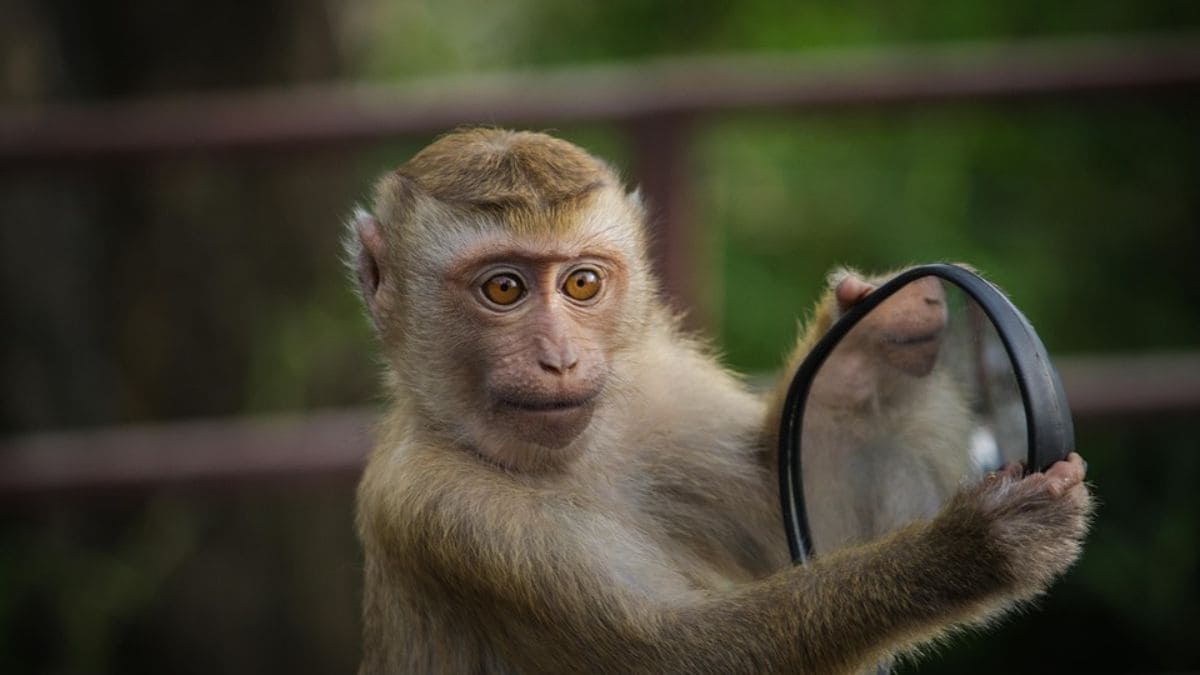
Baboons in their natural habitat have been observed looking at their reflections in mirrors but failing to recognise themselves. Despite reacting to a visible dot on their arms or legs, the primates showed little to no response when a laser dot was projected onto their faces while they were in front of a mirror. The findings suggest that wild baboons may lack self-awareness, a trait previously observed in some other species under laboratory conditions. The research raises questions about whether self-recognition in animals is innate or developed through experience.
Study Conducted on Wild Baboons
According to a study published in the Proceedings of the Royal Society B: Biological Sciences, experiments were conducted in Namibia’s Tsaobis Nature Park over five months. Large mirrors were set up near water sources frequented by two troops of chacma baboons (Papio ursinus). When the baboons looked into the mirrors, researchers directed a laser dot onto their cheeks or ears to assess their reactions. The study aimed to determine whether these primates could associate the reflection with their bodies.
Findings Suggest a Lack of Self-Recognition
Alecia Carter, an evolutionary anthropologist at University College London, told Science News that self-awareness is a complex concept, making it difficult to assess in animals. The mark test, which involves placing an unseen mark on an animal’s face and observing its reaction in a mirror, has previously been used to test self-recognition in chimpanzees, orangutans, dolphins, and even some fish species.
Despite showing interest in the mirrors, the baboons did not react to the marks on their faces. When laser dots were placed on visible body parts like arms or legs, 64 per cent of the 91 baboons tested touched the spot. However, out of 51 baboons who looked in the mirror while the dot was on their face or ear, only one responded. Some appeared to notice the mark but did not attempt to touch their faces.
Self-Awareness May Exist on a Spectrum
James Anderson, a primatologist at Kyoto University, told Science News that the research supports existing findings that non-ape primates do not recognise themselves in mirrors. While some trained rhesus monkeys in lab conditions have learned to use mirrors for self-exploration, the baboons in this study displayed no such behaviour.
Masanori Kohda, an animal sociologist at Osaka Metropolitan University, suggested that the laser mark may not have been perceived as part of the baboons’ bodies. He noted that since the dot does not move in sync with their face, the primates may have interpreted it as a mark on the mirror itself rather than on their reflection.
Psychologist Lindsay Murray from the University of Chester highlighted that self-awareness in humans develops gradually, with only 65 per cent of children passing the mirror test by the age of two. She stated that an increasing number of researchers now consider self-awareness as a trait that exists on a continuum rather than a binary characteristic.
Carter pointed out that self-awareness may not be necessary for survival in baboons. She stated that the primates thrive in their natural environment without needing to recognise their own reflections, suggesting that self-recognition may not be essential for all species.
