

Close Menu
  • Home
  • Stock
  • Parenting
  • Personal
  • Fashion & Beauty
  • Finance & Business
  • Marketing
  • Health & Fitness
  • Tech & Gadgets
  • Travel & Adventure

Subscribe to Updates

Subscribe to our newsletter and never miss our latest news

Subscribe my Newsletter for New Posts & tips Let's stay updated!

What's Hot

NYC women are doing pull-ups on scaffolding, streetlights and subway rails

agosto 21, 2026

Fitness coach Leroy Saunders dies during HYROX competition

agosto 20, 2026

3 workout mistakes that are ruining your sleep

agosto 19, 2026
Facebook X (Twitter) Instagram
  • Home
  • Contact us
  • DMCA
  • Política de Privacidad
  • Publicidad en DD Noticias
  • Sobre Nosotros
  • Términos y Condiciones
Facebook X (Twitter) Instagram
DD Noticias: Tu fuente de inspiración diariaDD Noticias: Tu fuente de inspiración diaria
  • Home
  • Stock
  • Parenting
  • Personal
  • Fashion & Beauty
  • Finance & Business
  • Marketing
  • Health & Fitness
  • Tech & Gadgets
  • Travel & Adventure
DD Noticias: Tu fuente de inspiración diariaDD Noticias: Tu fuente de inspiración diaria
Home » NASA Tracks GNSS Signals on Moon, Advancing Lunar Navigation Technology
Technology & Gadgets

NASA Tracks GNSS Signals on Moon, Advancing Lunar Navigation Technology

Jane AustenBy Jane Austenmarzo 11, 2025No hay comentarios2 Mins Read
Facebook Twitter Pinterest LinkedIn Tumblr Email
NASA Tracks GNSS Signals on Moon, Advancing Lunar Navigation Technology
Share
Facebook Twitter LinkedIn Pinterest Email


NASA, in collaboration with the Italian Space Agency, has successfully demonstrated the ability to acquire and track Earth-based navigation signals on the Moon. The breakthrough was achieved through the Lunar GNSS Receiver Experiment (LuGRE), which was delivered to the lunar surface by Firefly Aerospace’s Blue Ghost lander on March 2. The achievement confirms that Global Navigation Satellite System (GNSS) signals can be detected at the Moon’s distance, offering a potential advancement for future space missions, including NASA’s Artemis programme. The ability to track these signals on the Moon could enhance autonomous navigation for spacecraft, reducing reliance on Earth-based tracking systems. The LuGRE payload, one of ten NASA payloads sent aboard the lander, is expected to continue gathering data for the duration of its 14-day mission.

LuGRE Confirms GNSS Signal Tracking on the Moon

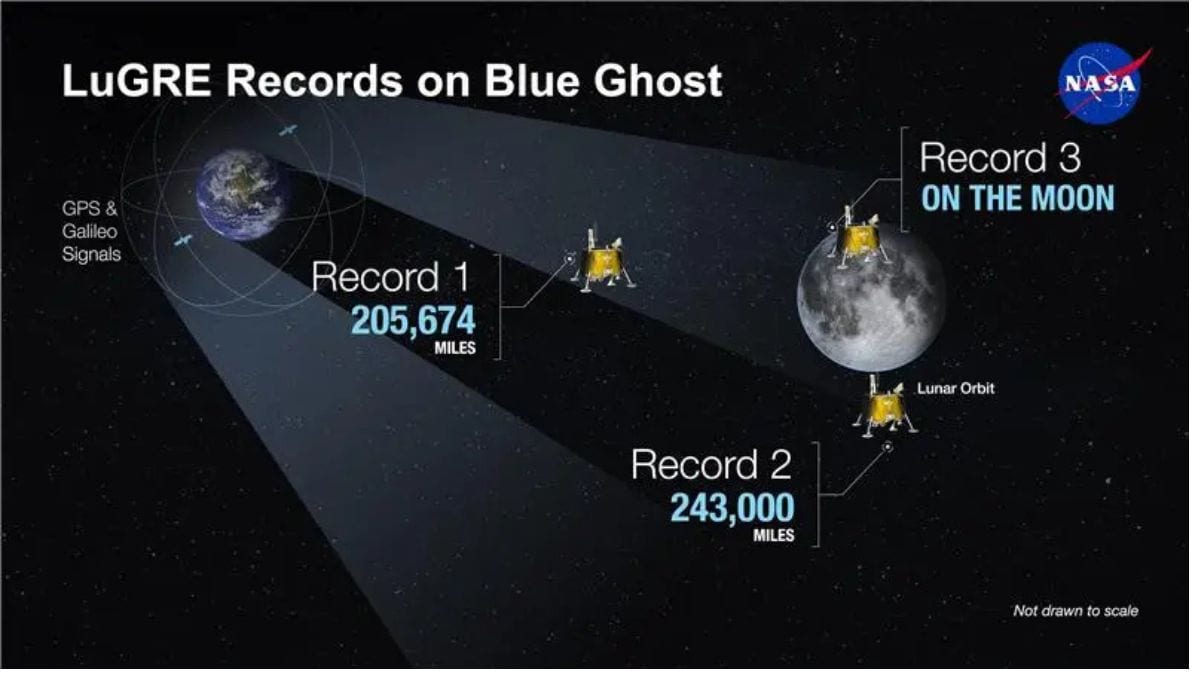
According to NASA’s Goddard Space Flight Center, the LuGRE experiment successfully acquired and tracked signals from both GPS and Galileo constellations at 2 a.m. EST on March 3. This marked the first time that GNSS signals had been used for navigation at a distance of approximately 225,000 miles from Earth. The data collected will contribute to the development of navigation technology that could support future lunar and deep-space exploration.

Kevin Coggins, Deputy Associate Administrator for NASA’s Space Communications and Navigation (SCaN) programme, told NASA’s official news source that the experiment demonstrated the feasibility of using GNSS signals for navigation beyond Earth. He highlighted that the same technology used in aviation and mobile devices on Earth could now be leveraged for lunar missions.

Record-Breaking GNSS Acquisition in Space

The LuGRE payload had already set records during its journey to the Moon. On January 21, it achieved the highest altitude GNSS signal acquisition at 209,900 miles from Earth, surpassing the previous record set by NASA’s Magnetospheric Multiscale Mission. By February 20, as LuGRE entered lunar orbit, the altitude record had been extended to 243,000 miles. These milestones suggest that spacecraft operating in cislunar space could use GNSS signals for navigation, providing greater autonomy for missions beyond Earth’s orbit.

Developed through a partnership between NASA’s Goddard Space Flight Center, the Italian Space Agency, Qascom, and Politecnico di Torino, the LuGRE payload represents a significant step toward advanced space navigation systems. Data collected from the ongoing mission will inform future efforts to expand GNSS coverage for lunar and Martian exploration.


Source link

Share. Facebook Twitter Pinterest LinkedIn Tumblr Email
Jane Austen
  • Website

Related Posts

Bitcoin Core v30 allenta OP_RETURN: Alcuni miner S19 affrontano una pressione di booster

noviembre 17, 2025

Bitcoin Core v30: No es una actualización — es presionar el 「booster de eliminación de mineros」

noviembre 17, 2025

Pika Labs Launches Social AI Video App on iOS, Unveils New Audio-Driven Video Generation AI Model

agosto 12, 2025
Add A Comment
Leave A Reply Cancel Reply

Editors Picks

Fast fashion pioneer Forever 21 files for bankruptcy — again

marzo 18, 2025

Dow gains 350 points as stocks climb for 2nd day after S&P 500 enters correction

marzo 18, 2025

Yellow Creditors Have Own Plan to Share Trucker’s $550 Million

marzo 18, 2025

Alphabet in Talks to Buy Startup Wiz for $30 Billion, WSJ Says

marzo 18, 2025
Top Reviews
DD Noticias: Tu fuente de inspiración diaria
Facebook X (Twitter) Instagram Pinterest Vimeo YouTube
  • Home
  • Contact us
  • DMCA
  • Política de Privacidad
  • Publicidad en DD Noticias
  • Sobre Nosotros
  • Términos y Condiciones
© 2026 ddnoticias. Designed by ddnoticias.

Type above and press Enter to search. Press Esc to cancel.