


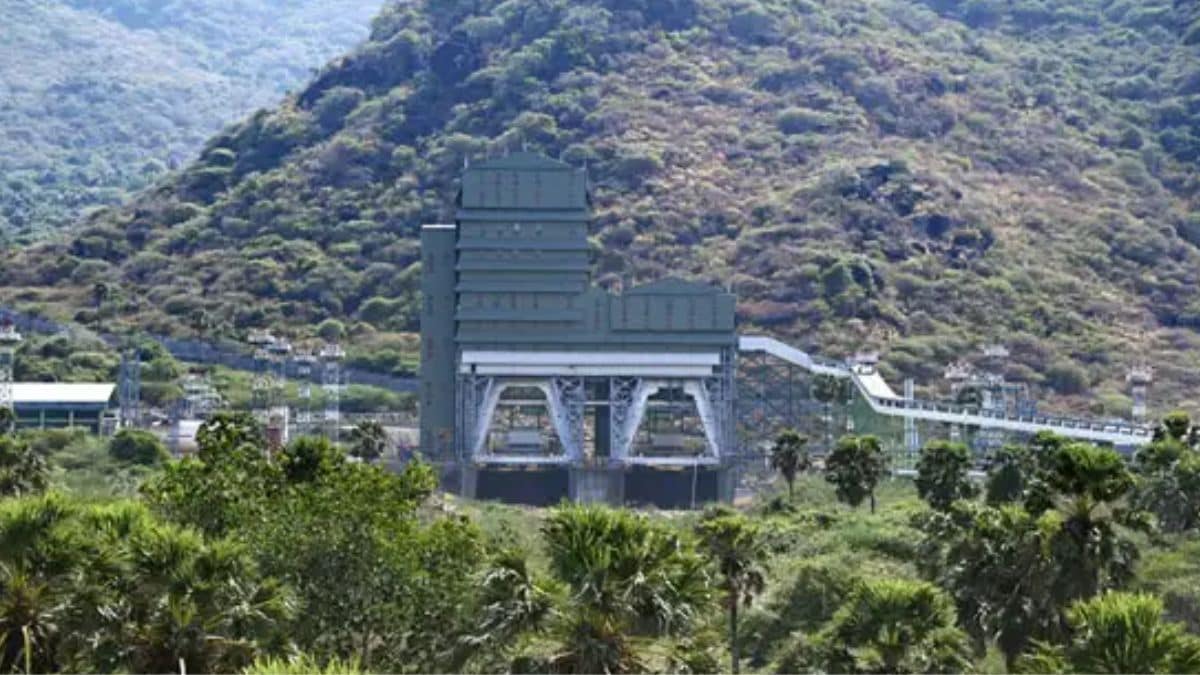
The Indian Space Research Organisation (ISRO) has carried out a significant hot test on the semi-cryogenic engine SE2000, marking a key advancement in the development of propulsion technology for future heavy-lift space missions. The test, known as the Power Head Test Article (PHTA), was conducted to assess the integrated performance of vital engine subsystems, including the gas generator, turbo pumps, pre-burner, and control components. This milestone brings ISRO closer to achieving a functional cryogenic stage necessary for launch vehicle booster propulsion.
Validation of Key Engine Systems
As per reports, according to ISRO, the PHTA test involved a hot-firing that lasted 4.5 seconds. This evaluation was crucial in characterising the ignition of the pre-burner and validating the performance of essential engine elements. The propulsion system, standing at approximately three metres, was tested without the thrust chamber.
Earlier efforts to conduct a similar test in July 2023 at ISRO’s Mahendragiri facility were halted due to technical issues. Since then, extensive modifications have been made to enhance the system’s reliability. The semi-cryogenic engine being developed is designed to generate a thrust of 2,000 kiloNewton (kN), providing improved efficiency for space missions.
Advancements in Propulsion Systems
ISRO has been focusing on liquid oxygen (LOX) and kerosene-based propulsion systems, which offer advantages over conventional cryogenic engines. Unlike liquid hydrogen, which must be stored at -253 degrees Celsius, kerosene is more stable and cost-effective. These semi-cryogenic systems also allow for higher-density impulse and greater operational flexibility.
The space agency has been working towards optimising the Launch Vehicle Mk III (LVM3) by integrating a C32 cryogenic upper stage. This modification will enable a 25% increase in payload capacity, allowing spacecraft to carry up to 5.1 tonnes to the Geosynchronous Transfer Orbit without added costs.
Next Generation Launch Vehicle (NGLV) Development
As part of ongoing preparations for the Gaganyaan missions, ISRO is progressing with the Next Generation Launch Vehicle (NGLV). The vehicle, designed for human-rated missions, will incorporate reusable first-stage technology and LOX-based propulsion for enhanced payload capacity of up to 30 tonnes in Low Earth Orbit.
V Narayanan, Chairman of ISRO and Secretary, Department of Space, stated in an address that research is underway to develop advanced propulsion systems. These innovations aim to facilitate long-distance space travel by enabling transitions between atmospheric and cryogenic engine modes mid-flight.
Efforts are also being directed at recovering and reusing launch vehicle components, a capability that has recently been demonstrated in preliminary experiments. ISRO continues to refine its propulsion technologies, with further tests expected to improve the efficiency and reliability of upcoming space missions.
