


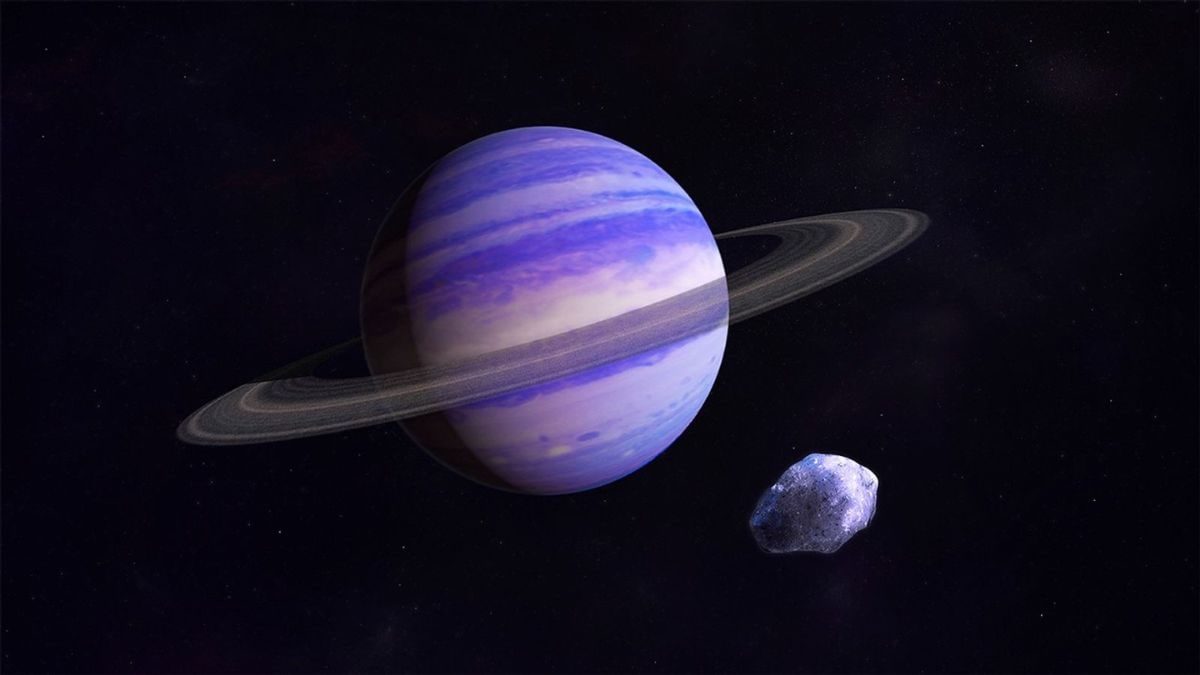
A potential record-breaking exoplanet system has been identified, moving at a speed of at least 1.2 million miles per hour (540 kilometers per second). The discovery suggests a low-mass star is traveling through the Milky Way with a planet in orbit, marking a significant find in the study of high-velocity celestial bodies. If confirmed, this would be the first instance of a planet orbiting a hypervelocity star, nearly doubling the speed at which the solar system moves through the galaxy.
Microlensing Data Reveals a High-Velocity Star
According to a study published in The Astronomical Journal, the system was detected through microlensing observations. Scientists analyzed data from the Microlensing Observations in Astrophysics (MOA) project, which recorded a significant lensing event in 2011. Microlensing, a phenomenon where a massive object bends light from a background star, allowed researchers to infer the presence of two celestial bodies with a mass ratio of approximately 2,300 to 1. However, the exact masses remain uncertain due to the unknown distance of the system from Earth.
David Bennett, Senior Research Scientist at the University of Maryland, College Park and NASA’s Goddard Space Flight Center, stated in an official press release by NASA, that while determining the mass ratio is straightforward, calculating the actual masses requires further observation. The initial findings suggested two possible scenarios: a star about 20 percent the Sun’s mass with a planet approximately 29 times Earth’s mass, or a rogue planet around four times Jupiter’s mass accompanied by a smaller moon.
Follow-Up Observations Strengthen Findings
To determine the most probable explanation, astronomers examined data from the Keck Observatory in Hawaii and the European Space Agency’s Gaia satellite. A potential host star was identified around 24,000 light-years away, located in the Milky Way’s galactic bulge. By tracking its movement between 2011 and 2021, its exceptionally high speed was calculated.
Aparna Bhattacharya, Research Scientist at the University of Maryland, College Park and NASA Goddard, said that further observations will confirm whether the identified star is the same one responsible for the microlensing signal. If the star remains in a fixed position, the possibility of a rogue planet with a moon would be favored instead.
Future Research to Confirm System’s Nature
The system’s true velocity may exceed the Milky Way’s escape speed of approximately 1.3 million miles per hour (600 kilometers per second). If so, it could eventually leave the galaxy, entering intergalactic space.
Sean Terry, Postdoctoral Researcher at the University of Maryland, College Park and NASA Goddard, told that NASA’s upcoming Nancy Grace Roman Space Telescope will help refine the understanding of planetary systems around fast-moving stars. The telescope’s high-resolution imaging will eliminate the need for multiple observatories, providing clearer insights into these rare celestial formations.
