


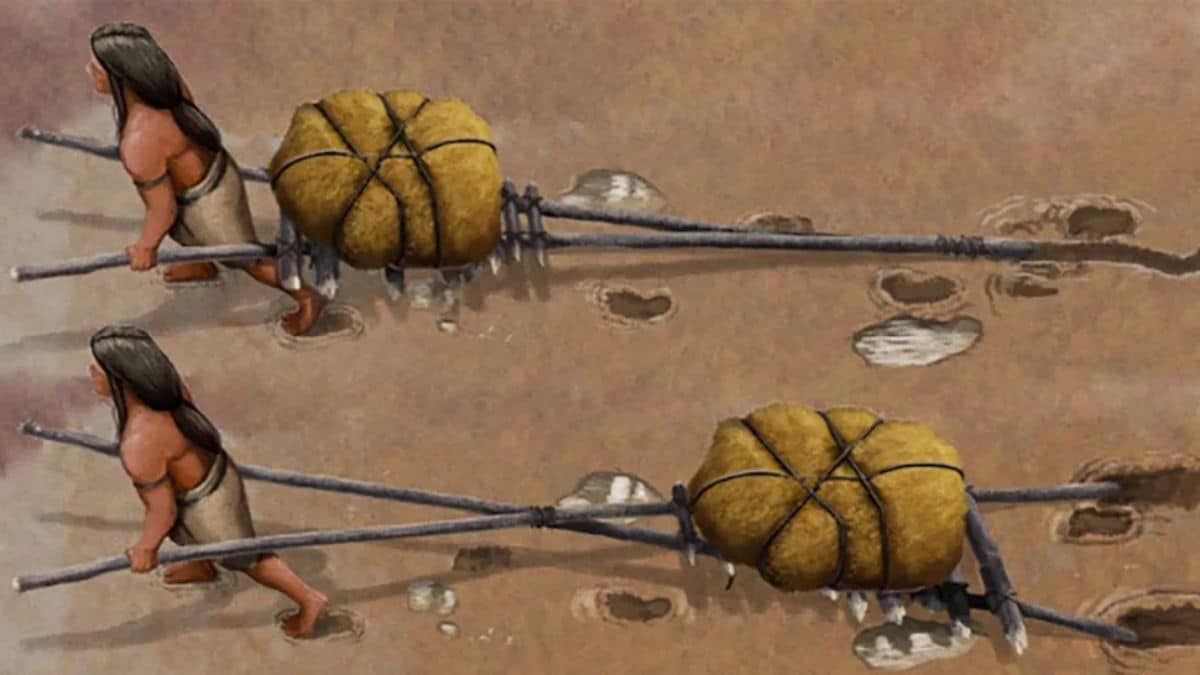
Marks resembling sled-like tracks alongside footprints at White Sands National Park in New Mexico suggest that wooden travois-style transport was used by the earliest known Americans over 20,000 years ago. Researchers studying the site believe that ancient inhabitants of the region utilised wooden poles bound together to drag goods and possibly people across the landscape. Indigenous knowledge and experimental archaeology indicate that these marks likely originated from a rudimentary form of transport, which predates the use of wheels.
Findings from White Sands National Park
According to the study published in Quaternary Science Advances, drag marks extending up to 50 metres were identified alongside human footprints. The marks varied in form, with some appearing as single lines—suggesting an A-shaped structure—while others showed two parallel lines, indicative of an X-shaped design. The study’s lead author, Matthew Bennett, Professor of Environmental and Geographical Sciences at Bournemouth University, stated in an official press release that these traces provide the first direct evidence of how early humans transported heavy loads.
Comparison with Indigenous Practices
Indigenous groups from the Great Plains, including parts of present-day New Mexico, historically used similar structures to transport homes and belongings. These were initially pulled by dogs and later by horses after European contact. The study’s findings suggest that similar methods may have been employed thousands of years earlier, with adults pulling the travois while children walked alongside. Co-author Sally Reynolds, a mammalian palaeontologist at Bournemouth University, said that understanding ancient movement patterns is key to reconstructing the lives of early settlers in the Americas.
Testing the Travois Theory
To verify the hypothesis, researchers constructed travois replicas using wooden poles and tested them in muddy terrains in the UK and the US. The resulting marks closely resembled those found at White Sands. These tests reinforced the idea that prehistoric people likely used similar methods to transport goods across harsh environments.
Implications for Early American History
Previous research at White Sands has dated human footprints at the site to between 21,000 and 23,000 years ago, challenging earlier estimates of human arrival in North America. While some scholars debate these dates, the presence of drag marks alongside footprints remains a significant indicator of early transport methods. The study highlights an ancient yet sophisticated means of mobility long before the advent of the wheel.
For details of the latest launches and news from Samsung, Xiaomi, Realme, OnePlus, Oppo and other companies at the Mobile World Congress in Barcelona, visit our MWC 2025 hub.

T Coronae Borealis Nova Event: When and Where to See the ‘Blaze Star’
Qualcomm Launches Dragonwing Fixed Wireless Access Gen 4 Elite Platform Alongside Qualcomm X85 5G Modem-RF at MWC 2025

