


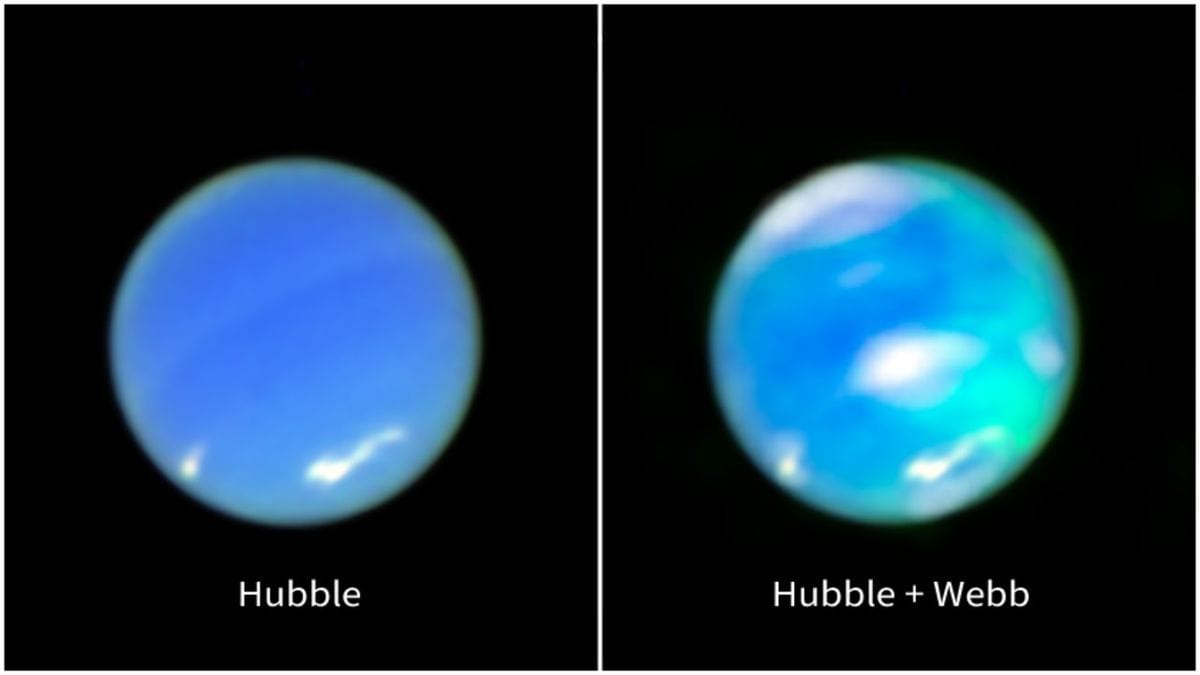
Neptune’s elusive auroras have been captured for the first time in newly released images. It offers an unprecedented look at the ice giant’s atmospheric activity. After decades of conjecture, the occurrence of these auroras has been confirmed by direct visual evidence from the James Webb Space Telescope (JWST). Their presence had been hinted at by earlier observations, such as the Voyager 2 flyby data, but photographing them had proven difficult. The telescope’s near-infrared capabilities, which allowed for the remarkably clear detection of these emissions, have been credited with the breakthrough.
Results of the Research
Reportedly, according to research conducted at Northumbria University and the University of Leicester,Neptune’s auroras are said to be very different from those seen on other planets. Neptune’s auroras can be seen in unexpected places, in contrast to Earth, Jupiter, and Saturn, where auroral activity is usually focused near the poles. This anomaly has been linked to the planet’s highly tilted and offset magnetic field, which directs charged particles from the solar wind in unpredictable ways.
Henrik Melin, a planetary scientist at Northumbria University, stated that seeing the auroras with such precision was unexpected.
Role of H₃⁺ and Temperature Decline
Data collected using JWST’s Near-Infrared Spectrograph (NIRSpec) provided additional insights into Neptune’s ionosphere, where auroras form. A key discovery was the presence of trihydrogen cation (H₃⁺), an ion commonly associated with auroral emissions on gas giants. JWST scientist Heidi Hammel explained that detecting H₃⁺ was crucial. She said that H3+ has been a clear signifier on all the gas giants—Jupiter, Saturn, and Uranus—of auroral activity and they expected to see the same on Neptune, highlighting that previous ground-based efforts had failed to confirm this.
Temperature measurements taken from the JWST observations also revealed a striking finding—Neptune’s upper atmosphere has cooled significantly since Voyager 2’s 1989 flyby. Melin noted that the recorded temperature in 2023 was just over half of what was observed during the spacecraft’s visit. The decrease in temperature may have contributed to the difficulty in detecting auroras, as cooler conditions result in weaker emissions.
Future Observations and Research
The study has reinforced the need for infrared-sensitive instruments in future missions aimed at studying the outer planets. Leigh Fletcher, a planetary scientist at the University of Leicester, said that JWST’s ability to capture Neptune’s auroras has set a new benchmark. He stated that this observatory has opened the window onto this last, previously hidden ionosphere of the giant planets. Scientists plan to conduct further observations to understand Neptune’s atmospheric and magnetic interactions fully.
