


BANGKOK (AP) — World shares and U.S. futures were mostly higher on Wednesday following a rocky session on Wall Street after Canada, Mexico and China were hit by steep U.S. tariffs that took effect the day before.
Comments by U.S. President Donald Trump in a speech to Congress and the nation appeared to have scant impact on world markets. The future for the S&P 500 was up 0.6%, while that for the Dow Jones Industrial Average gained 0.5%.
Germany’s DAX surged 2.4% to 22,958.74 as the prospective partners in the country’s next government said they want to loosen rules on limiting debt to allow for higher defense spending, an issue that has gained urgency given the wavering U.S. commitment to European allies.
The CAC 40 in Paris jumped 1.9% to 8,197.43, while Britain’s FTSE 100 advanced 0.7% to 8,819.57.
China announced it intends to keep its economy growing at around a 5% annual pace in 2025, in line with last year’s target, as it opened the annual session of its largely ceremonial legislature. Premier Li Qiang also promised more government spending and other measures to support growth.
Hong Kong’s Hang Seng index jumped 2.8% to 23,594.21, while the Shanghai Composite index climbed 0.6% to 3,341.96.
Some Chinese commentators noted that Beijing had been bracing for tariffs of up to 60%. As of Tuesday, Trump has pushed import duties on Chinese products to 20%.
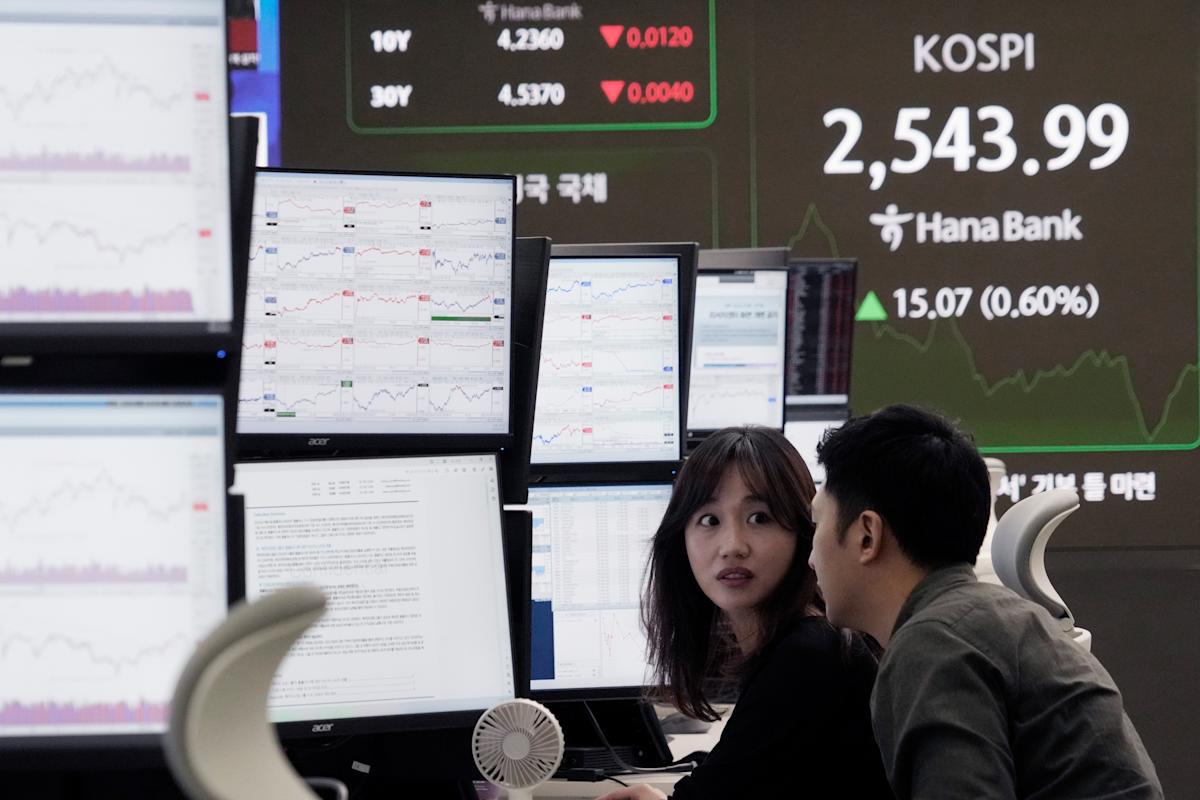
Tokyo’s Nikkei 225 index edged 0.2% higher to 37,418.24. In South Korea, the Kospi gained 1.2% to 2,558.13, while Australia’s S&P/ASX 200 shed 1.2% to 8,141.10.
On Tuesday, U.S. stocks racked up more losses on Wall Street as the trade war between the U.S. and its key trading partners escalated.
The Trump administration imposed 25% tariffs on imports from Canada and Mexico starting Tuesday as well as doubling tariffs for Chinese exports. All three countries have announced retaliatory actions, sparking worries about a slowdown in the global economy.
“The global trade outlook for 2025 is marked by solid growth amid significant challenges, many of which can be traced back to the policies proposed by U.S. President Trump,” economists at ING said in a report.
But global trade is diverse, with the United States accounting for just 13.6% of total global exports and a similar share of global imports. China’s exports to the rest of Asia have been surging and that can help offset reduced trade with the United States, they noted.
On Tuesday, the S&P 500 fell 1.2%, with more than 80% of the stocks in the benchmark index closing lower. The Dow slid 1.6% and the Nasdaq composite slipped 0.4%.
Story Continues
