


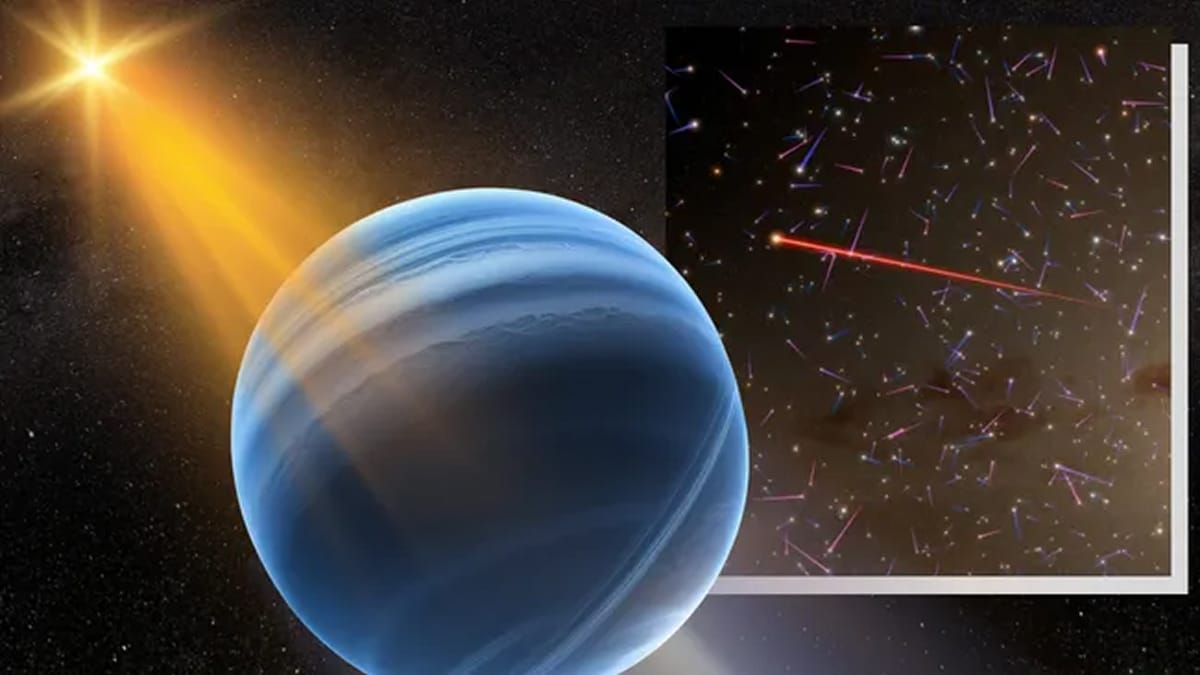
A planet believed to be a Neptune-like world is suspected to be orbiting a hypervelocity star moving at a staggering 1.9 million kilometres per hour, making it the fastest known exoplanetary system ever observed. If confirmed, this would mark the first instance of a planet being found accompanying such a rapidly moving star. The discovery was made by a team of NASA researchers who analysed data that dates back to 2011. The existence of this system was identified through microlensing, a technique predicted by Albert Einstein’s general theory of relativity, which allows the detection of distant cosmic bodies by observing how their gravity bends the light from background stars.
Discovery Through Microlensing
According to a study published in The Astronomical Journal, a signal indicating the presence of two objects was detected. NASA’s Goddard Space Flight Center researcher Sean Terry stated to Space.com that the system is thought to consist of a super-Neptune orbiting a low-mass star at a distance comparable to the space between Venus and Earth.
The gravitational lensing effect enabled scientists to determine the mass ratio between the two objects, though the exact measurements remain uncertain. David Bennett, a senior research scientist at the University of Maryland and NASA Goddard, explained to Space.com that calculating the mass ratio is straightforward, but pinpointing the exact masses is significantly more complex due to the system’s distance.
A Star and Its Planet or a Rogue Planet and a Moon?
Data from 2011 suggested that the larger object could either be a low-mass star or a rogue planet, with the smaller body potentially being either a Neptune-like exoplanet or a moon. To clarify this, researchers revisited observational records from the Keck Observatory in Hawaii and the European Space Agency’s Gaia mission.
The team concluded that if the primary object were a rogue planet, it would not be visible without gravitational lensing. If it were a star, its brightness would confirm its identity. The latter scenario was supported by follow-up observations, which identified a bright object approximately 24,000 light-years away near the densely populated central region of the Milky Way.
Potential Intergalactic Journey
The star’s movement over a decade was assessed, revealing its extreme velocity. If additional three-dimensional velocity components are factored in, the speed could exceed 1.3 million miles per hour (600 kilometres per second), surpassing the Milky Way’s escape velocity. This would suggest that both the star and its exoplanet may eventually leave the galaxy.
University of Maryland researcher Aparna Bhattacharya mentioned to Space.com that further high-resolution observations are planned to determine whether the 2011 lensing event corresponds to this suspected hypervelocity system.
The upcoming launch of the Nancy Grace Roman Space Telescope in 2027 is expected to provide more insights into hypervelocity stars and their potential planetary companions, with mission lead Sean Terry highlighting its capacity for comprehensive surveys without the need for additional telescopes.
