


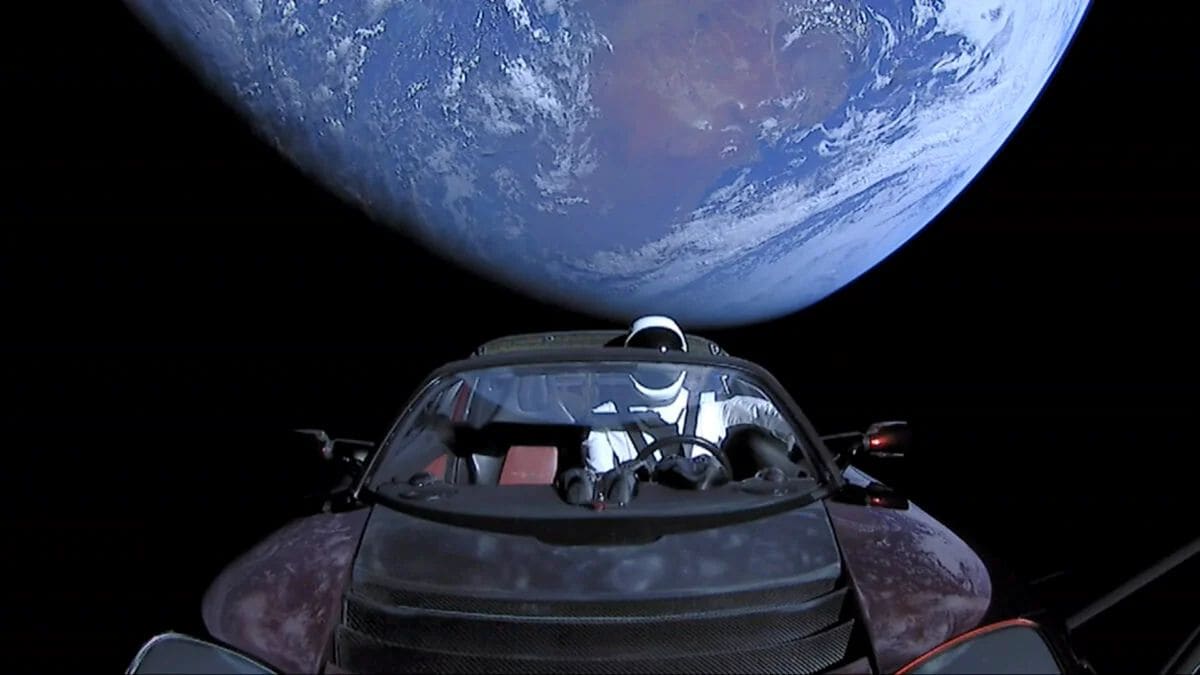
A near-Earth object recently classified as an asteroid has been identified as Elon Musk’s Tesla Roadster, which was launched into space in 2018 aboard a SpaceX Falcon Heavy rocket. The object was mistakenly listed as a new near-Earth asteroid by the International Astronomical Union’s Minor Planet Center (MPC) on January 2, before the classification was withdrawn within hours. The error, made by an amateur astronomer in Turkey using publicly available data, underscores growing concerns over the tracking of space debris and its impact on astronomical observations.
Identification Error and Retraction
According to astronomy.com, the object was initially recorded in the MPC’s database under the designation 2018 CN41. The classification was based on historical tracking data, but after a review, the discovery was rescinded just 17 hours later. The astronomer who reported the object recognised the mistake upon further analysis.
The Tesla Roadster was launched on February 6, 2018, as a test payload for SpaceX’s Falcon Heavy’s maiden flight. Positioned in the driver’s seat was a mannequin named “Starman,” dressed in a prototype spacesuit. The car was intended to enter a stable orbit around Mars but instead settled into a heliocentric orbit, periodically passing near Earth and Mars.
Implications for Space Tracking
Jonathan McDowell, an astronomer at the Harvard-Smithsonian Center for Astrophysics, told astronomy.com that the misidentification of human-made objects as natural space bodies is becoming more frequent. He warned that such mistakes could lead to significant financial losses, stating that the worst-case scenario was that a billion dollars were spent launching a space probe to study an asteroid, only to realise it’s not an asteroid when you get there.
Over the years, multiple spacecraft and discarded rocket boosters have been temporarily classified as asteroids. Among them are the European Space Agency’s Rosetta spacecraft, NASA’s Lucy probe, and the European-Japanese BepiColombo mission. With the increasing number of space missions, experts anticipate that misidentifications will become more common.
Lack of Regulations on Deep Space Debris
As per reports, space agencies and private companies are required to track satellites and debris in Earth’s orbit. However, no regulatory framework mandates tracking objects that have moved beyond Earth’s gravity, such as the Tesla Roadster. In a 2024 statement, the American Astronomical Society called for transparency in tracking space objects to minimise interference with scientific observations and prevent potential collisions. With space exploration accelerating, concerns over orbital debris and misidentified objects continue to grow, reinforcing the need for stricter monitoring and classification systems.g
