


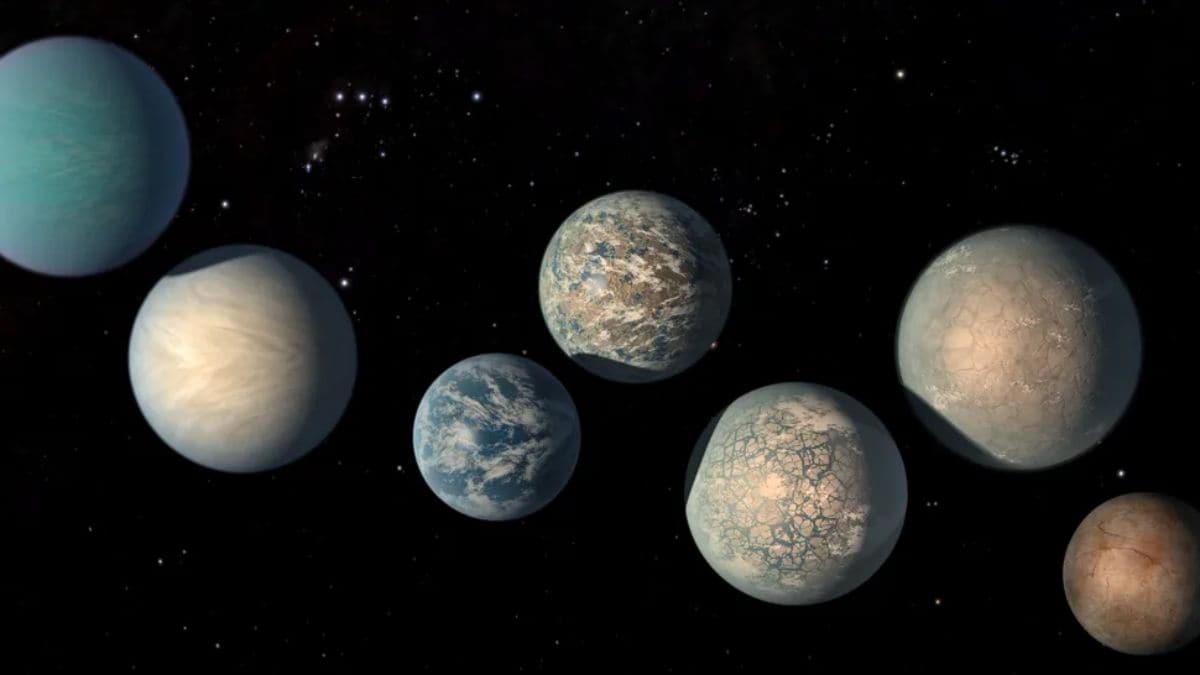
A team of U.S.-based astronomers is building a new kind of coronagraph — one powered by quantum mechanics — that could enable direct imaging of Earth-like exoplanets previously considered too faint or too close to their host stars to detect. Traditional telescopes have advanced since Galileo’s time, with instruments like the James Webb Space Telescope (JWST) now capable of analysing distant planetary atmospheres. But even these devices generally are not able to capture images of planets and asteroids that orbit nearby bright stars, as their light is frequently drowned out. Now, a breakthrough could be in sight.
Quantum-Sensitive Coronagraph May Revolutionize Exoplanet Imaging With Sub-Diffraction Precision
As per a recent Space.com report, researchers from the University of Arizona and the University of Maryland have developed a “quantum-sensitive” coronagraph that filters starlight before it reaches the telescope’s detector. By exploiting differences in the spatial modes of photons — how light waves behave in space — the device physically separates planetary light from overwhelming stellar glare. “This method routes photons to different regions before they even hit the sensor,” one co-author explained, emphasising its superiority to digital image processing.
This experimental device uses a “spatial mode sorter”, a series of precision-crafted optical phase masks that redirect light waves from exoplanets, allowing astronomers to view them below the diffraction limit. Normally, achieving this resolution would require telescopes too massive for current spaceflight capabilities. But quantum engineering may bypass that need altogether, provided that light purity — known as mode fidelity — reaches the stringent 1-in-a-billion requirement needed to block star photons while preserving exoplanet signals.
In lab tests, researchers successfully simulated star-planet systems and demonstrated that their system could resolve a dim, Earth-like planet even when positioned one-tenth the distance modern coronagraphs can handle. At higher star-to-planet contrast ratios — up to 1,000:1 — the device maintained accuracy within a few percentage points of theoretical limits, showcasing its potential for space-based observatories.
The technology could augment missions like NASA’s upcoming Habitable Worlds Observatory, designed to detect biosignatures on exoplanets. While scientists caution that the method isn’t a standalone solution, they believe it could dramatically expand the toolkit for planetary discovery. The findings were published on April 22 in Optica.
For the latest tech news and reviews, follow Gadgets 360 on X, Facebook, WhatsApp, Threads and Google News. For the latest videos on gadgets and tech, subscribe to our YouTube channel. If you want to know everything about top influencers, follow our in-house Who’sThat360 on Instagram and YouTube.

iPhone 16 Pro Max, iPhone 15, MacBook Air (M4) and More Get Discounts During Vijay Sales Apple Days Sale
Trump Threatens 25 Percent Tariffs on Apple If iPhones Not Made in US

