


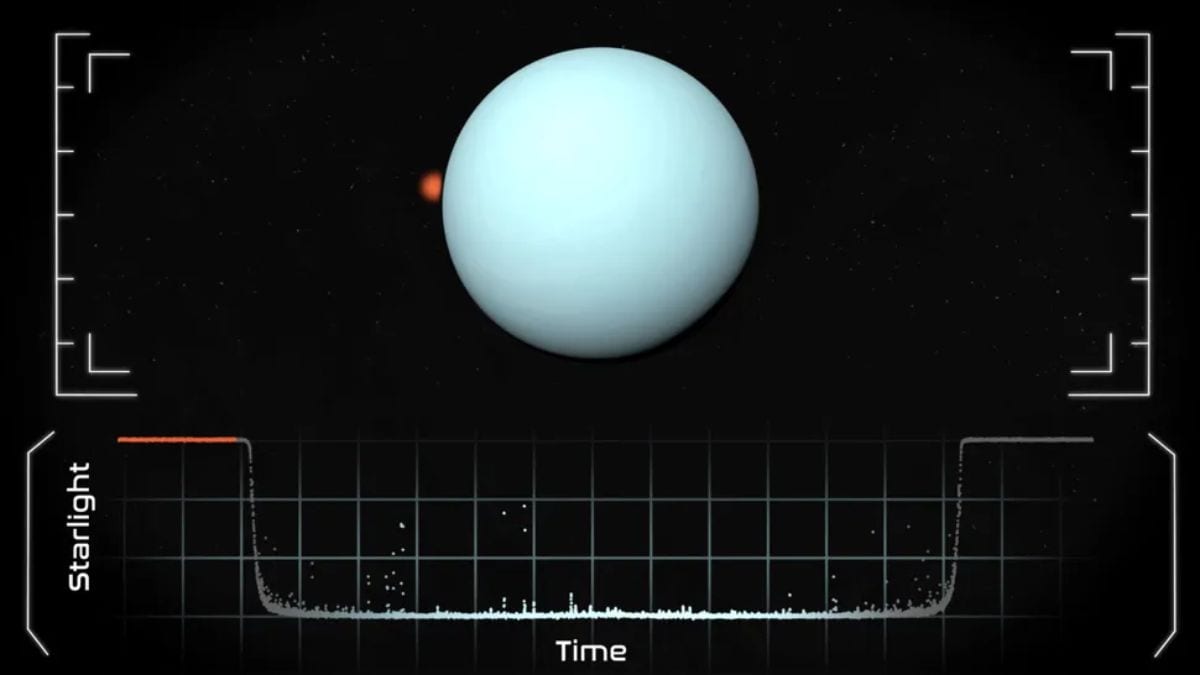
NASA’s astronomers got a rare chance to study Uranus when the planet moved in front of a distant star — a rare event called a «stellar occultation.» The occultation of Uranus occurred the morning of the April 7th and lasted for one hour. The occulation was visible from western North America and it was the first bright Uranian occultation since 1996. The Langley NASA Research Centre mobilised an international team of more than 30 scientists who combined observations from 18 observatories to gather important facts. The contribution of these two groups, together, led to phase coverage being restored and was key to the possibility of investigating the vertical structure of its atmosphere.
NASA’s Rare Uranus Occultation Unlocks New Atmospheric and Ring Discoveries
According to Space.com, planetary scientist William Saunders stressed the enormity of the effort and that it could not have been accomplished without the help of every telescope. “By observing this occultation from so many large telescopes at so many altitudes, we can determine the temperature structure of Uranus’ atmosphere at a level of detail that was not possible before,” Saunders stated. As per NASA’s official release, the newly gathered data could significantly advance plans for future Uranus exploration missions.
During the occultation, researchers measured the temperatures and chemical composition of Uranus’ stratosphere, capturing changes unseen since the last event nearly three decades ago. Uranus is about 2 billion miles (3.2 billion kilometres) from Earth. Uranus has no firm surface; rather, it is covered by a swirling mass of water, ammonia, and methane clouds. This low-freezing-point substance is the slushy, icy layer that veneers a volumetric rocky mantle, which is surrounded by an atmosphere of mostly hydrogen and helium.
The scientists also observed that ice and gas giants like Uranus may be natural laboratories for learning about atmospheres. This absence of solid ground means that cloud formation, storm development, and connections between wind patterns are all part of a unified system— a kind of warm, wet, swirling ocean of air that we call the atmosphere.
This is according to postdoctoral researcher Emma Dahl of the California Institute of Technology. “We can find out why we have clouds, why we have storms, and why we have wind, not from the many thousands of objects that we have on the surface here on the Earth, but from the total atmosphere that we have over the mountain,” Dahl said in the NASA statement.
Over the next six years, Uranus will occult several dimmer stars, offering further chances to observe the process, according to NASA officials. But the next big event with a brighter star is expected in 2031, presenting yet another opportunity for astronomers to refine their ideas of this remote ice giant’s highly active atmosphere and delicate rings.
